 Aemeath
caed976e63
- The real portal over a router that lives in the page
  (web/src/portal/demo): "User" on "Dawnline Preview", ten scenarios
  (first visit, settings changed, out of data, outside the hours, paused,
  ended, plain HTTP, plain WireGuard, no free slots), devices kept per
  visitor in localStorage. Keys are random and the server's address never
  resolves: nothing is installed and nothing connects
- A "Demo" chip after the breadcrumb opens a drawer with the scenarios and
  Start over; a new device "connects" a few seconds after its settings
- A GitHub pill beside the page's QR knob; on a phone, where the names
  need the room, a GitHub button in the drawer instead
- npm run build:demo builds the static site into web/dist/demo;
  web/vercel.json deploys it with the portal's CSP and headers, and builds
  only commits on main that change web/
- README links to the live demo (dawnline-demo.vercel.app)
- Tests for the demo router (tests/demo.test.ts)

Dawnline
Your OpenWrt router as a private VPN for the people you choose.


Quick start · Live demo · Features · How it works · Screenshots · FAQ · Development
Dawnline runs an AmneziaWG server on your OpenWrt router and gives every person you invite a personal link. They open it, add their own phones and computers and connect with AmneziaVPN, AmneziaWG or WireGuard. You decide what each of them may reach (the home network, the internet, or both) and for how long, how much and when.
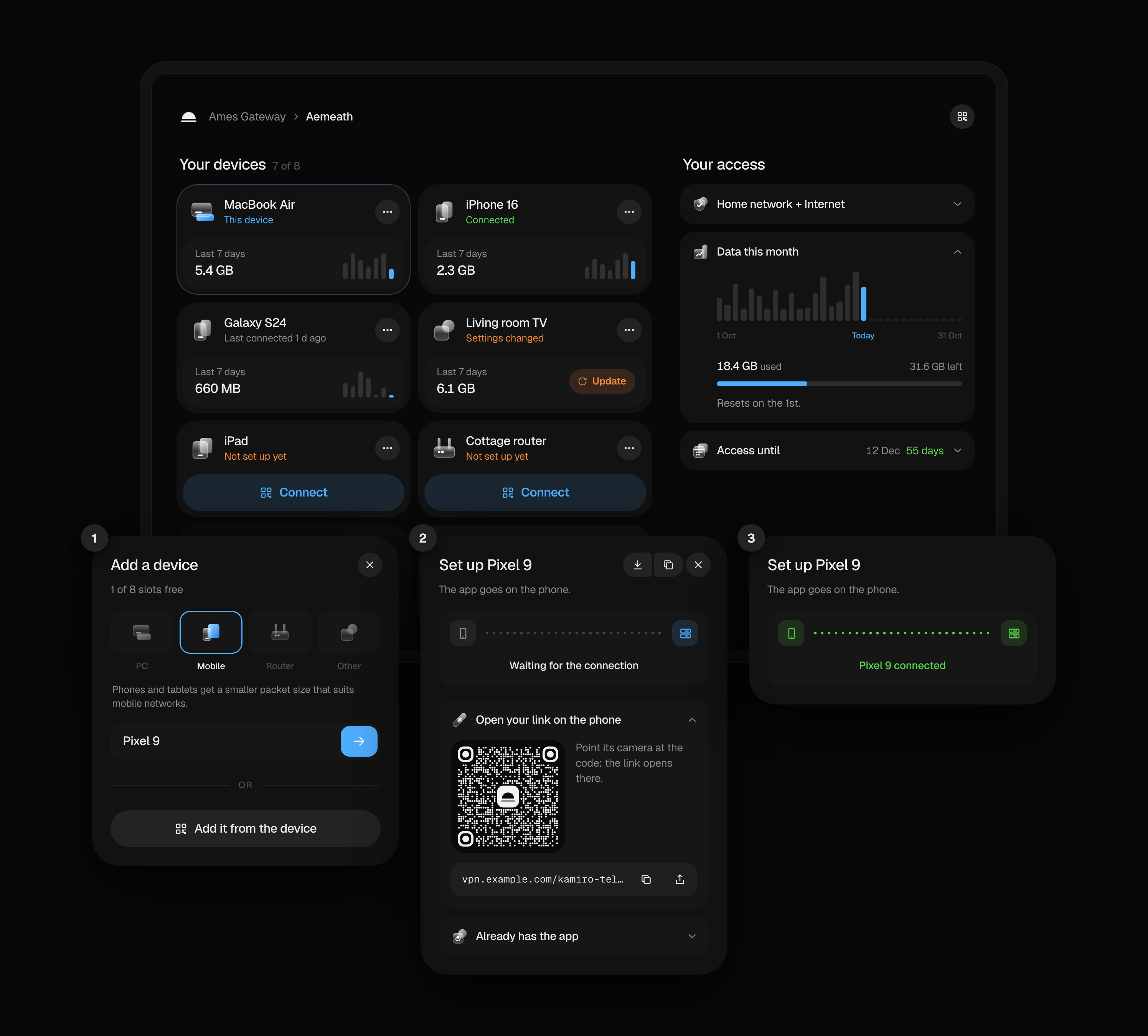
A person's own page: their devices and access. Adding a phone takes three steps, and the page sees it connect.
Try it in the live demo: nothing installs and nothing connects.
💡 Why Dawnline?
Sharing a home VPN usually means making a config file by hand, sending it over a messenger and hoping nobody shares it further. Dawnline turns that around:
| A VPN by hand | With Dawnline | |
|---|---|---|
| Setting up a device | You make a config and send it | They add it themselves from their link |
| Who can do what | Everyone gets the same | Home, internet or both, per person |
| Ending access | Find and delete their peers | A date, a data limit, or one click |
| Knowing what goes on | Read wg show |
Who is online, traffic, places, a log |
| When something breaks | You find out from them | A watchdog notices and repairs it |
It is the successor of Liminal: the same idea rebuilt around people instead of peers, with a personal portal, limits, live traffic and a LuCI admin that follows a modern design.
🚀 Quick start
-
Install on the router (it asks before it changes anything):
sh -c "$(wget -qO- https://raw.githubusercontent.com/tickcount/luci-app-dawnline/main/install.sh)" -
Set up in LuCI: Network › Dawnline, and follow the wizard. It suggests the port, the public address and the networks.
-
Invite someone: Add person, then send them the link or the invite card with its QR code. They do the rest.
Tip
Behind Cloudflare, give the portal a port Cloudflare proxies: 2053, 2083, 2087, 2096 or 8443.
✨ Features
🔗 A link, not an accountThree words, like |
📱 Their own devicesPeople add, rename and remove devices up to their limit. Adding one walks them through it: the right app, then a QR code, a link, a key or a file. |
👥 People, not peersOne card per person with their devices, who is online, traffic, end date and data limit. Filter by who needs attention or is paused. |
🧭 Who reaches whatThe home network, the internet or both; only some networks or devices at home (a NAS, Home Assistant). Family sees family, guests see guests. |
⏳ LimitsEnd dates, monthly or total data limits, allowed hours, a pause button. Changes apply at once, without dropping anyone else's connection. |
🕶️ DisguisePresets that make the VPN traffic harder to spot and block, with what each one needs from the apps. |
🏠 Internet like a home devicePeople's devices go online the way the devices at home do, so your proxies, ad and DNS filters cover them too. |
🗺️ Overview and placesWho is online with what, speed now, the last 30 days, and a map of where people connect from, at city level. |
🩺 Repairs itselfHealth checks with one-click fixes, and a watchdog that checks the tunnels, access rules and portal every minute and mends them. |
📦 Updates and backupsDawnline and AmneziaWG built for your firmware in one place; nightly backups, and export and import to move to another router. |
🧩 How it works
flowchart LR
    you(["🛠️ You, in LuCI"]) -- "add a person" --> link["🔗 Their link"]
    link -- "they open it" --> portal["📱 Their portal"]
    portal -- "add a device" --> app["App and connection"]
    app == "AmneziaWG tunnel" ==> router["🌅 Dawnline<br>on your router"]
    router -- "if allowed" --> home["🏠 Home network"]
    router -- "if allowed" --> net["🌍 Internet"]
- You add a person in LuCI and choose what they may reach, their device limit, an end date or a data limit.
- They open their link on any device. The portal is theirs alone: it shows their devices and their access; access and limits stay yours to change.
- They add a device. The portal points them to the app for that system and hands over the connection; the router gives each device its own keys.
- The device connects through the router's AmneziaWG server, and Dawnline lets through what that person may reach, counts their traffic and keeps to their limits.
📸 A closer look

Overview: who is online, speed now, the last 30 days and a map of where people connect from.

People: online, ending soon, over the limit, outside their hours, paused. |

A person: their devices, traffic, places and limits. |
📋 Requirements
| What Dawnline needs | |
|---|---|
| OpenWrt | 24.10 (opkg, .ipk) or 25.12 (apk, .apk) |
| AmneziaWG | kmod-amneziawg, amneziawg-tools, luci-proto-amneziawg: the installer adds a build made for your firmware when they are missing |
| Free flash | about 2 MB |
📥 Install
sh -c "$(wget -qO- https://raw.githubusercontent.com/tickcount/luci-app-dawnline/main/install.sh)"
The installer checks the firmware, the clock, free space and DNS, lets you pick
a release (the latest is the default), shows the plan and asks before it
changes anything. It downloads the package for your package manager, checks it
against sha256sums.txt, installs AmneziaWG built for your firmware if it is
missing, then installs Dawnline and checks that LuCI can reach it.
Note
Before changing anything it saves
/etc/config/{dawnline,network,firewall,dhcp,uhttpd}and the service state to/etc/dawnline/installer-backups/(the newest three are kept), and puts them back if a step fails. Packages are not rolled back: to return to an older release, run the installer with--tag. Everything it does is logged to/tmp/dawnline-install.log.
Installer options
With options, download it first:
wget -O /tmp/dawnline-install.sh https://raw.githubusercontent.com/tickcount/luci-app-dawnline/main/install.sh
sh /tmp/dawnline-install.sh --dry-run             # check everything, change nothing
sh /tmp/dawnline-install.sh -y --tag 0.3.1        # a given release, no questions
sh /tmp/dawnline-install.sh --awg grey            # AmneziaWG from 2Grey
| Option | |
|---|---|
-y, --yes |
No questions: the latest release (or --tag) and the recommended choices |
-n, --dry-run |
Check the system, resolve, download and verify the release; change nothing |
-v, --verbose / -q, --quiet |
More detail / only warnings and errors |
--tag X.Y.Z |
A given release (sh install.sh 0.3.1 works too) |
--awg auto|slava|grey|skip |
Where AmneziaWG comes from when it is missing: Slava-Shchipunov, then 2Grey (auto, the default), only one of them, or not at all (install it later from Dawnline → Updates). DAWNLINE_AWG does the same |
--no-awg |
Same as --awg skip |
When GitHub is slow or blocked
The installer retries downloads through ghfast.top and gh-proxy.com on its
own. To fetch the installer itself through a mirror:
sh -c "$(wget -qO- https://cdn.jsdelivr.net/gh/tickcount/luci-app-dawnline@main/install.sh)"
sh -c "$(wget -qO- https://ghfast.top/https://raw.githubusercontent.com/tickcount/luci-app-dawnline/main/install.sh)"
Installing by hand
From a release:
opkg update && opkg install ./luci-app-dawnline-0.1.0.ipk                 # OpenWrt 24.10
apk update && apk add --allow-untrusted ./luci-app-dawnline-0.1.0.apk     # OpenWrt 25.12
Upgrade from Dawnline › Updates, or run the installer again. Settings, keys and history are kept, and a backup is made first.
Remove
sh -c "$(wget -qO- https://raw.githubusercontent.com/tickcount/luci-app-dawnline/main/uninstall.sh)"
It backs up the configuration to /etc/dawnline/backups, runs Dawnline's own
removal (the same as Settings › Remove Dawnline from this router),
removes the package and cleans up what is left. After installing Dawnline
again, restore the backup in Settings › Backups.
Important
AmneziaWG stays installed, since other tunnels may use it. Add
--remove-awgto take it away too.
Uninstaller options
With options, download it first:
wget -O /tmp/dawnline-uninstall.sh https://raw.githubusercontent.com/tickcount/luci-app-dawnline/main/uninstall.sh
sh /tmp/dawnline-uninstall.sh --dry-run
| Option | |
|---|---|
-y, --yes |
Do not ask for confirmation |
-p, --purge |
Also delete the configuration, keys, history and every backup (/etc/config/dawnline, /etc/dawnline); no backup is made |
--remove-awg |
Also remove AmneziaWG, unless another interface still uses it (--keep-awg, the default, keeps it) |
-n, --dry-run |
Show what would be removed; change nothing |
By hand: Settings › Remove Dawnline from this router
(keeps a backup), then opkg remove luci-app-dawnline or
apk del luci-app-dawnline.
❓ FAQ
Which apps do people use?
AmneziaVPN or AmneziaWG on phones and computers, and plain WireGuard when the disguise is off. The portal shows each person the app for their system and how to add the connection in it.
What happens when someone loses their link?
Make a new one on their page. The old link stops working at once; their devices keep working, unless you tick the ones to remove with it.
Does it touch the rest of my router?
Only what it created, and dawnline teardown removes all of it. The full list
is under What Dawnline changes on the router.
How do I move to another router?
Export JSON in Settings › Backups on the old one, install Dawnline on the new one and import the file there.
Where do the places on the map come from?
From the address a device connects from, looked up at city level and cached on the router. It can be turned off in Settings.
🧾 What Dawnline changes on the router
Only objects it created: network interfaces tagged _dawnline, firewall
sections named dawnline_*, the inet dawnline nft table, /tmp/hosts/dawnline,
the dawnline network namespace with its two veth links (dlx0, dll0, the
latter a port of the LAN bridge, which needs kmod-veth), policy rules for the
tunnel interfaces with one routing table, a second dnsmasq instance on port
5354 (/var/etc/dawnline-dns.conf), a cron line for the agent's heartbeat
check and, while the portal is on, a uhttpd instance for it.
dawnline teardown removes all of them.
Data lives in /etc/config/dawnline (mode 0600, contains private keys) and
/etc/dawnline/ (usage, events, issued configurations, backups). Live counters
are kept in /var/run/dawnline and flushed to flash at most hourly. Access
changes reach the tunnel with awg syncconf, without restarting the interface;
dawnline log on the router shows the service log.
🧰 Development
package/luci-app-dawnline/
  root/usr/share/ucode/dawnline/   ucode library: model (core), AmneziaWG (awg), apply, live,
                                   ops, view, loop, portal
  root/usr/share/rpcd/ucode/       luci.dawnline RPC object
  root/usr/libexec/dawnline/       agent (usage, limits, presence) and updater
  root/usr/share/dawnline/portal/  portal CGI wrapper and its (minified) assets
  root/usr/bin/dawnline            command line (`dawnline help`)
  htdocs/                          LuCI views and the generated module dawnline/app.js
web/                               TypeScript sources of the admin UI and the portal
build/Dockerfile                   package build with the OpenWrt SDK
scripts/                           build, deploy and check scripts
cd web
npm ci
npm run format        # Prettier
npm run ci            # format check, types, tests, minified bundles

scripts/lint-ucode.py                    # static ucode checks
scripts/check-ucode.sh root@router       # compile every ucode file on a router
scripts/deploy.sh root@router            # install the working tree (backs up configs first)
scripts/build-packages.sh all            # .ipk and .apk with the OpenWrt SDK in Docker
scripts/capture-screenshots.mjs --demo   # README screenshots from a router, a demo cast in place of its people
scripts/frame-screenshots.py             # frame them for this README
The web bundles are committed: CI fails when they are out of date. Pushing a
tag vX.Y.Z (matching PKG_VERSION) builds both packages with the OpenWrt SDK
and publishes a release with sha256sums.txt.